For many people, a career in software development seems out of reach.
They assume they need a four-year computer science degree, expensive training programs, or years of formal education before they can begin applying for programming jobs.
The reality is often very different.
Many successful programmers are self-taught. They learned through books, online courses, personal projects, and a commitment to continuous learning. While a degree can certainly be helpful, it is not the only path into the software development profession.
The Demand for Software Developers
Technology continues to transform every industry. Organizations need developers to build websites, mobile applications, cloud solutions, automation tools, artificial intelligence systems, and business applications.
As a result, skilled programmers remain in demand across a wide range of industries.
Employers increasingly evaluate candidates based on their practical skills and their ability to solve real-world problems. A strong portfolio of projects can often demonstrate those abilities more effectively than a degree alone.
What Successful Self-Taught Programmers Have in Common
Over the years, I have worked with many successful software developers. Regardless of their educational background, the most successful individuals tend to share several characteristics:
- Curiosity and a desire to learn
- Persistence when solving difficult problems
- A willingness to build projects
- Strong communication skills
- A commitment to continuous improvement
Programming is not about memorizing syntax. It is about learning how to think through problems and create solutions.
Building Skills Through Practice
One of the biggest mistakes new programmers make is spending all of their time watching videos and reading books without actually writing code.
The best way to learn programming is by building projects.
Start with small applications.
Write simple programs.
Create a personal website.
Build a tool that solves a problem you encounter in your daily life.
Every project teaches valuable lessons that cannot be learned through theory alone.
Introducing the Book and Course
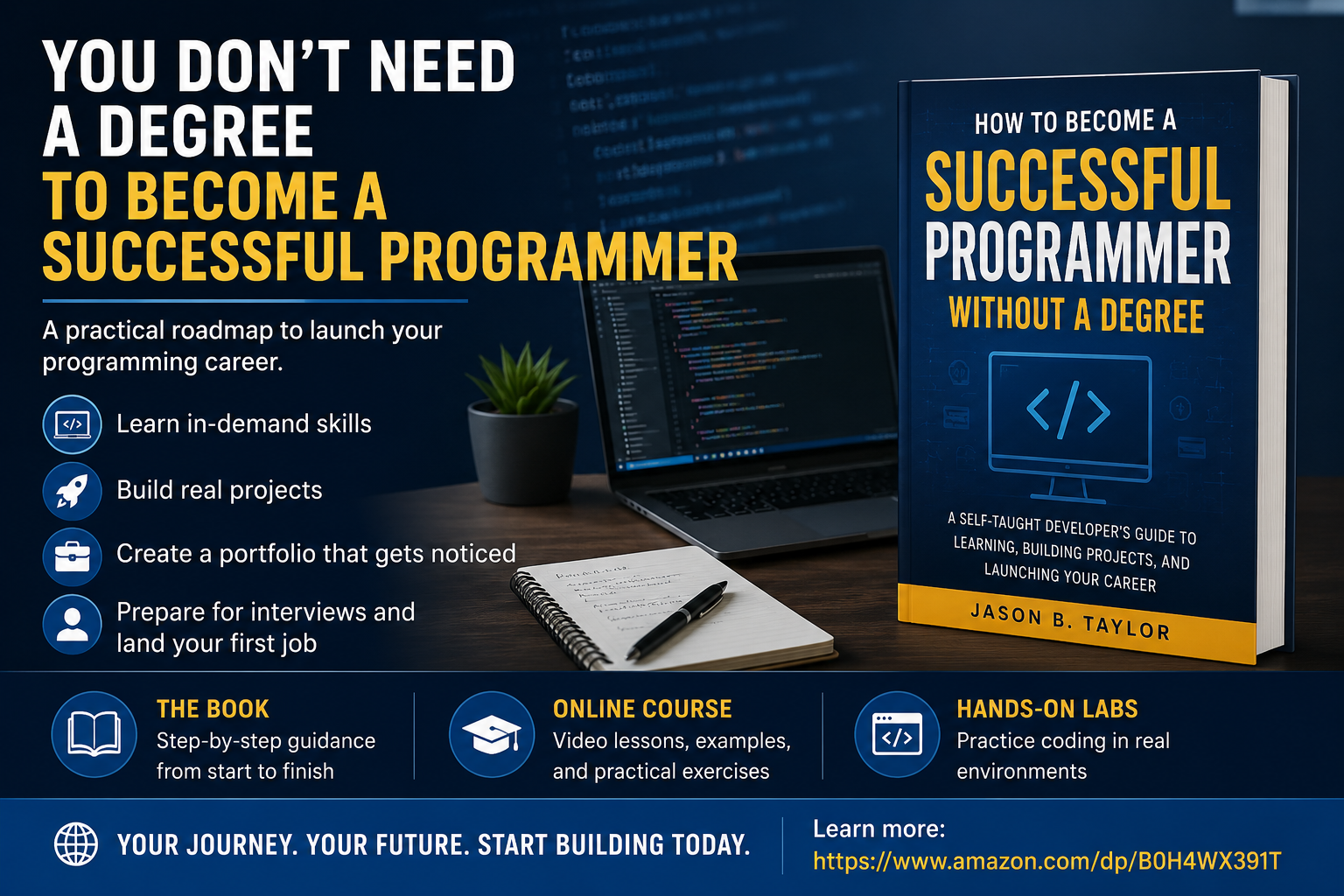
To help aspiring developers follow a practical roadmap into the profession, I created How to Become a Successful Programmer Without a Degree.
The book provides guidance on:
- Learning programming fundamentals
- Choosing technologies to study
- Building a portfolio
- Developing professional skills
- Preparing for interviews
- Navigating the job market
- Creating a long-term career plan
In addition to the book, students receive access to the accompanying online course and hands-on labs through the Destin Learning platform.
The course expands on the concepts discussed in the book and provides practical exercises designed to help students gain real-world experience.
You can learn more about the book on Amazon:
Book URL: https://www.amazon.com/dp/B0H4WX391T
Why Hands-On Learning Matters
Reading about programming is important.
Doing programming is essential.
The hands-on labs included with the course allow students to practice what they learn in a guided environment. This approach helps bridge the gap between theory and practical application.
By completing projects and exercises, students develop the confidence needed to tackle larger programming challenges.
Your Career Journey Starts Today
There has never been a better time to learn programming.
The tools are more accessible than ever.
The learning resources are abundant.
The opportunities are real.
Whether your goal is to change careers, increase your earning potential, build your own software products, or simply learn a valuable new skill, programming remains one of the most rewarding fields to enter.
The journey begins with a single step.
Keep learning, keep building, and keep moving forward.
You may be surprised by what you can accomplish.
Learn More
📖 Amazon Book: https://www.amazon.com/dp/B0H4WX391T
💻 Destin Learning Labs: https://labs.destinlearning.com
The combination of the book, online course, and hands-on labs provides a complete learning path for aspiring programmers who want to build practical skills and launch a successful career in software development.