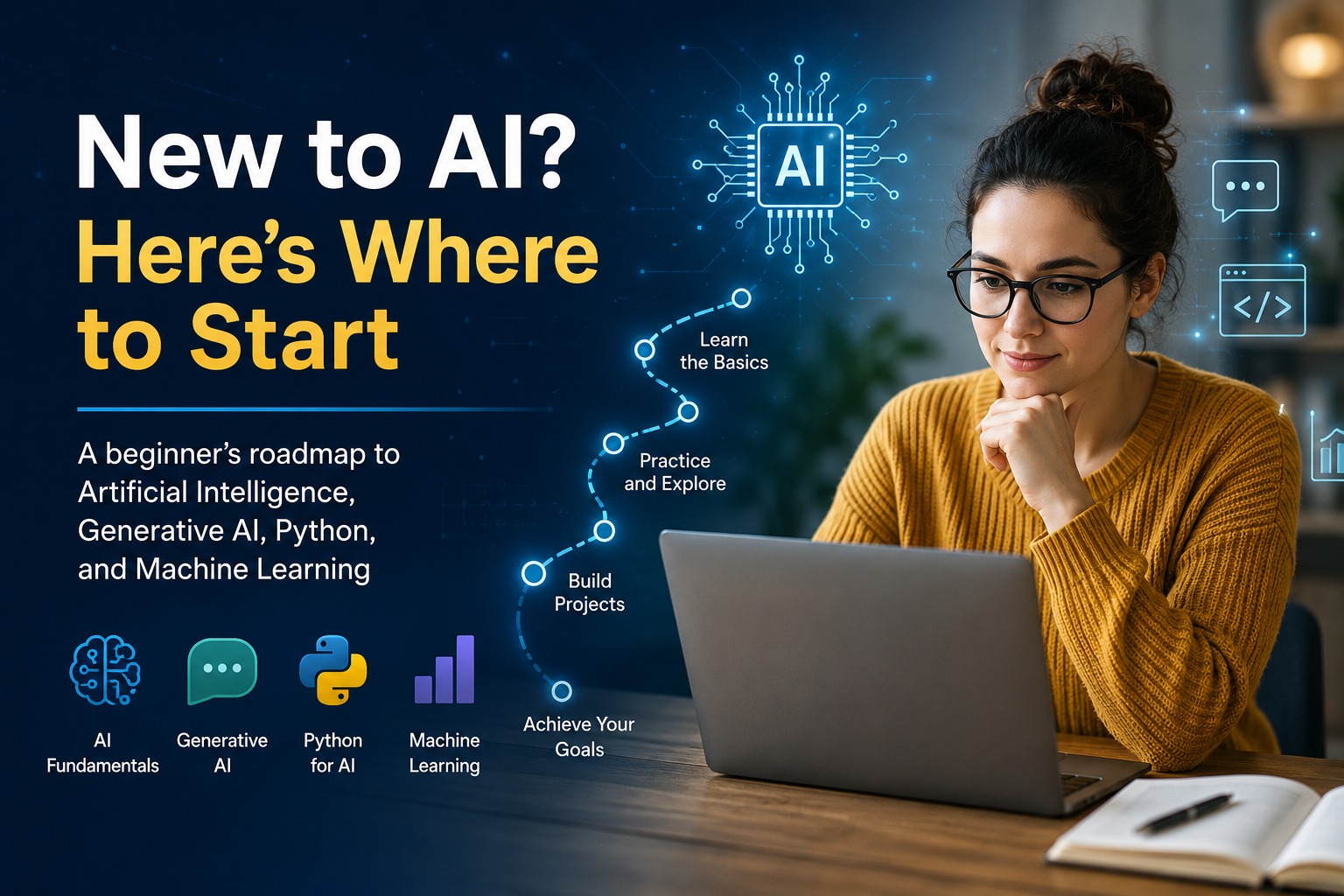
New to AI? Here's Where to Start
Artificial Intelligence is everywhere.
It's helping developers write code, assisting businesses with decision-making, creating images and videos, powering chatbots, and changing the way people work across nearly every industry.
If you've been thinking about learning AI, you're not alone.
The challenge is knowing where to begin.
Many newcomers assume that learning Artificial Intelligence requires advanced mathematics, a computer science degree, or years of programming experience. While some areas of AI can become highly technical, the truth is that anyone can start learning the fundamentals today.
In this article, I'll show you a practical roadmap for getting started with AI and explain how you can begin building valuable skills in one of the fastest-growing fields in technology.
What Is Artificial Intelligence?
Artificial Intelligence refers to computer systems that can perform tasks that normally require human intelligence.
Examples include:
- Understanding language
- Recognizing images
- Making recommendations
- Detecting patterns in data
- Generating content
- Answering questions
AI isn't something that's coming in the future—it's already here.
Every time Netflix recommends a movie, Google Maps suggests a faster route, Amazon recommends a product, or ChatGPT answers a question, Artificial Intelligence is at work.
The first step toward learning AI is simply understanding what it is and how it's being used in the real world.
Start by Exploring Generative AI
One of the easiest ways to begin learning AI is by using it.
Tools such as:
- ChatGPT
- Claude
- Gemini
allow anyone to interact with powerful AI systems through natural language.
Try asking questions such as:
- Explain cloud computing.
- Create a study guide for Python.
- Summarize this article.
- Generate business ideas.
- Help me write a professional email.
The more you experiment, the more you'll learn about what AI can—and cannot—do.
Learn the Basics of Prompt Engineering
AI systems respond to prompts, which are simply instructions provided by the user.
The quality of your prompt often determines the quality of the response.
For example, instead of asking:
Explain AI.
Try:
Explain Artificial Intelligence to a complete beginner using simple language and real-world examples.
A better prompt usually produces a better result.
Learning how to communicate effectively with AI systems is one of the most valuable skills you can develop.
Why Python Matters
If your goal is to build AI applications, Python is the language you should learn.
Python has become the standard programming language for Artificial Intelligence because it is:
- Easy to learn
- Widely used
- Supported by powerful AI libraries
- Used by professionals around the world
The good news is that you don't need to become an expert programmer before getting started with AI.
Many successful AI projects begin with a basic understanding of Python and a willingness to learn.
Understand Machine Learning
Machine Learning is one of the core technologies behind modern AI systems.
Machine learning allows computers to learn from data rather than relying entirely on rules written by programmers.
As a beginner, focus on understanding concepts such as:
- Training data
- Testing data
- Features and labels
- Predictions
- Supervised learning
- Unsupervised learning
You don't need advanced mathematics to understand these ideas. Building a solid foundation is much more important than trying to master complex algorithms immediately.
Build Small Projects
One of the best ways to learn AI is by building simple projects.
Examples include:
- A chatbot
- A text analyzer
- A study guide generator
- A resume review assistant
- A document summarizer
Projects help reinforce what you've learned and provide practical experience that employers and clients value.
They also form the foundation of a professional portfolio.
Think About Where AI Can Take You
Artificial Intelligence is creating opportunities in nearly every area of technology.
Popular career paths include:
- AI Engineer
- Machine Learning Engineer
- Data Scientist
- Software Developer
- Data Analyst
- AI Consultant
You don't need to know exactly where you want to end up.
The important thing is to start learning and exploring.
Over time, you'll discover which areas of AI interest you most.
A Simple Roadmap for Learning AI
If you're just getting started, I recommend the following path:
- Learn the fundamentals of Artificial Intelligence.
- Experiment with Generative AI tools.
- Practice prompt engineering.
- Learn basic Python programming.
- Study machine learning concepts.
- Build small projects.
- Create a portfolio.
- Continue learning and growing.
The key is consistency.
You don't need to learn everything this month. Small steps taken consistently over time can produce remarkable results.
Start Learning AI Today
To help beginners get started, I've created a free online course called AI Starter Course.
The course is designed specifically for people who are new to Artificial Intelligence and want a practical introduction without being overwhelmed by technical details.
Inside the course, you'll learn:
- What Artificial Intelligence is
- How Generative AI works
- How to use ChatGPT, Claude, and Gemini
- Prompt engineering fundamentals
- Python for AI
- Machine learning basics
- AI career opportunities
The course also includes hands-on labs that allow you to apply what you've learned in a browser-based environment.
Enroll Free
You can access the complete AI Starter Course here:
https://labs.destinlearning.com/course/ai-starter-course
Whether you're exploring a new career path, expanding your technical skills, or simply curious about AI, this course provides a practical and approachable starting point.
The future belongs to those who understand how to work with Artificial Intelligence.
There's no better time to begin than today.