Build Software the Right Way, From Design to Deployment
A comprehensive course for technical professionals who want to engineer software with discipline, clarity, and long-term maintainability in mind.
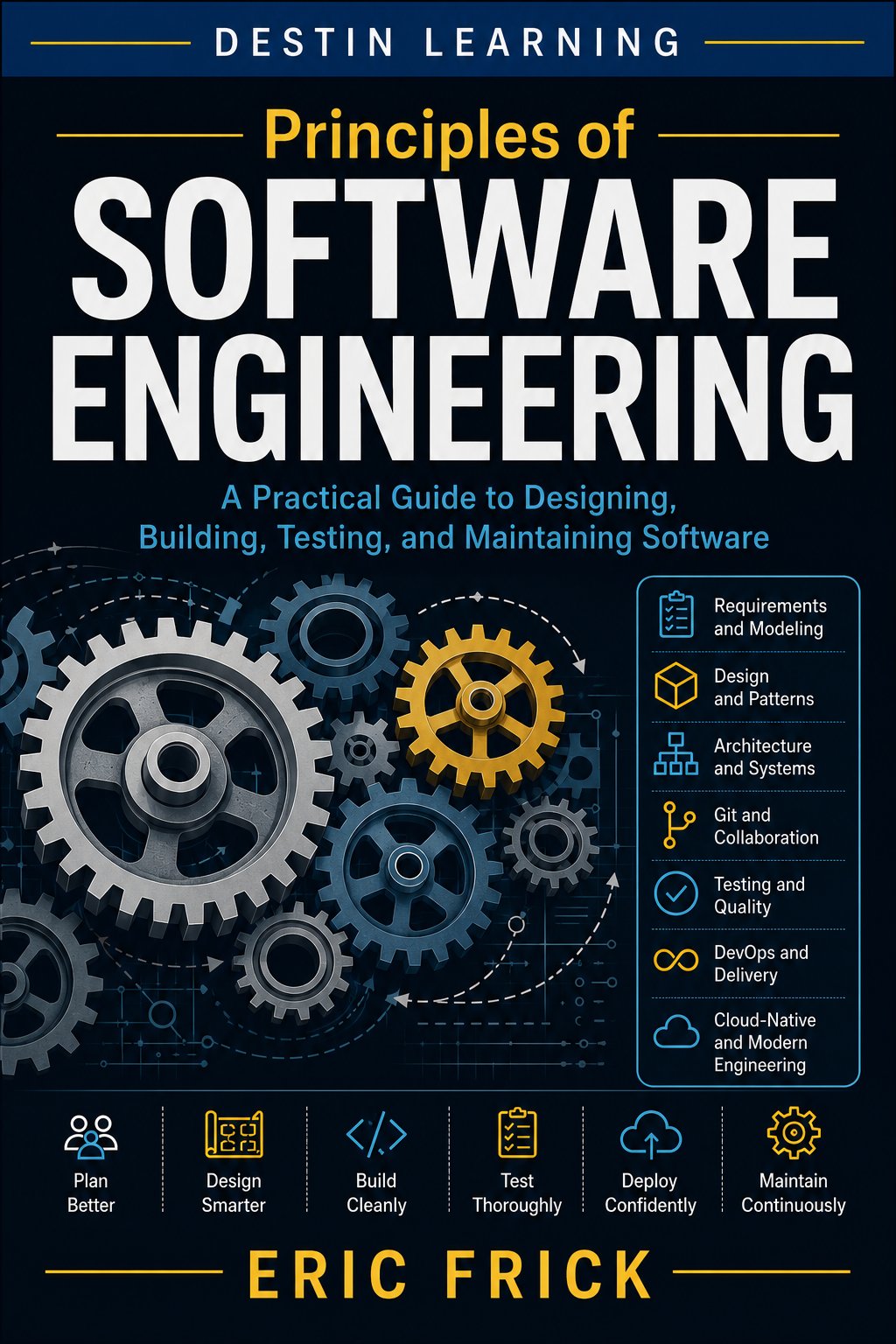
This course takes you from foundational process models and requirements engineering through architecture, testing, security, DevOps, and cloud-native design. You will finish with the vocabulary, judgment, and practical skills to contribute meaningfully to software projects at any scale. Whether you are writing your first requirements document or refactoring a legacy system, every module connects theory directly to what engineers do on real teams.
Have a coupon code? Redeem it here
What you'll gain
You will apply SOLID principles, established design patterns, and sound architectural thinking to write code that is easier to extend, test, and hand off to others.
From gathering requirements and modeling systems to deploying with CI/CD pipelines and monitoring production, you will understand how each phase of development connects to the next.
Fourteen hands-on labs let you practice on a running course project — a Task Management System — so every concept you study has a concrete, working application.

Who this course is for
You can write working code but want a stronger foundation in how professional software is designed, tested, and maintained. This course gives you the engineering vocabulary and practices that experienced teams expect.
You have studied algorithms and data structures but have limited exposure to real-world software processes. This course bridges the gap between academic coursework and what software engineering looks like in practice.
You work in a technical field — QA, DevOps, product, or systems administration — and want a structured understanding of software engineering principles. This course assumes comfort with basic programming concepts and builds from there.
What you'll learn
The course opens with software development processes and requirements engineering, establishing a shared framework for how software gets planned and built. From there, modules on design principles, object-oriented patterns, and architecture teach you how to structure systems that are coherent and maintainable. Later modules address the operational side of engineering — source control, testing, security, DevOps, and cloud-native design — before closing with a forward-looking look at AI-assisted development and the professional responsibilities of software engineers. Each module builds directly on the one before it, so concepts introduced early resurface with greater depth as the course progresses.
Module 1
Introduction to Software Engineering and Development Processes
6 lessons
▾
Module 2
Requirements Engineering
3 lessons
▾
Module 3
Principles of Good Software Design and Modeling
7 lessons
▾
Module 4
Object-Oriented Design and SOLID Principles
5 lessons
▾
Module 5
Software Design Patterns
4 lessons
▾
Module 6
Software Architecture
5 lessons
▾
Module 7
Source Control and Collaborative Development
4 lessons
▾
Module 8
Writing Maintainable Software
5 lessons
▾
Module 9
Software Testing and Quality Assurance
5 lessons
▾
Module 10
Secure Software Engineering
4 lessons
▾
Module 11
DevOps, Continuous Delivery, and Software Maintenance
7 lessons
▾
Module 12
Cloud-Native and Distributed Software
4 lessons
▾
Module 13
AI-Assisted Software Engineering
5 lessons
▾
Module 14
Software Engineering as a Profession
6 lessons
▾
Learn by doing
Every major concept in this course has a corresponding lab where you apply it to a real codebase or the course's running project. You will write requirements documents, produce UML diagrams, refactor Python applications, build automated test suites with pytest, write Dockerfiles, and use an AI coding assistant — working in the same environments and with the same tools used on professional software teams.
- Write functional and nonfunctional requirements for a Task Management System
- Develop user stories and acceptance criteria for its initial feature set
- Identify design weaknesses in a poorly structured Python application
- Refactor the application applying modularity, cohesion, and separation of concerns
- Produce use-case and class diagrams for the Task Management System
- Produce a sequence diagram for one core workflow
- Identify SOLID violations in an existing Python codebase
- Refactor the codebase to comply with SOLID principles
- Implement the Strategy and Observer patterns in a Python module
- Implement the Repository pattern to isolate data access
- Refactor a single-file application into presentation, business logic, and data layers
- Document the new architecture with a component diagram
- Create a feature branch, commit incremental changes, and open a pull request
- Resolve a merge conflict and merge the feature into the main branch
- Identify at least three code smells in a provided Python application
- Refactor the application to eliminate duplication and improve naming and structure
- Write unit tests for the Task Management System's core logic using pytest
- Measure and improve test coverage
- Identify authentication, input validation, and secrets-handling weaknesses in a sample app
- Correct the identified weaknesses and verify the fixes
- Write a Dockerfile for the Task Management System
- Build a CI workflow that runs the automated test suite on every push
- Identify modernization opportunities in a small legacy application
- Apply the strangler pattern to incrementally replace one legacy component
- Redesign the Task Management System as a set of stateless, twelve-factor services
- Diagram how the redesigned system would scale and recover from failure
- Use an AI coding assistant to generate tests and suggest a refactor for an existing module
- Independently validate the AI's suggestions before applying any change
Destin Learning
Destin Learning creates practical, project-driven courses for developers, IT professionals, and tech enthusiasts who want to build real skills — not just pass a certification exam.
Every course is built around hands-on labs, working code, and real-world tools. Our students learn by doing: writing programs, configuring systems, and solving problems in environments that mirror what they'll encounter on the job.
Our courses cover systems programming, Linux administration, cloud infrastructure, AI and machine learning, and foundational computer science — all taught with the same philosophy: understand it deeply, build it yourself, and know why it works.
Destin Learning · destinlearning.com
Enroll Now and Start Building Better Software
Contact us for pricing — self-paced video lessons and fourteen hands-on labs are included with enrollment.
Have a coupon code? Redeem it here