Build End-to-End Machine Learning Pipelines in Python
Master the full ML workflow with scikit-learn — from exploratory data analysis and feature engineering to tuning, deployment, and model interpretation.
This course takes you through every stage a working ML project actually requires: cleaning messy data, building leak-free pipelines, selecting and tuning models, and saving a trained pipeline ready for production. You'll finish with hands-on experience across the complete scikit-learn ecosystem and a final project that ties every skill together.
Have a coupon code? Redeem it here
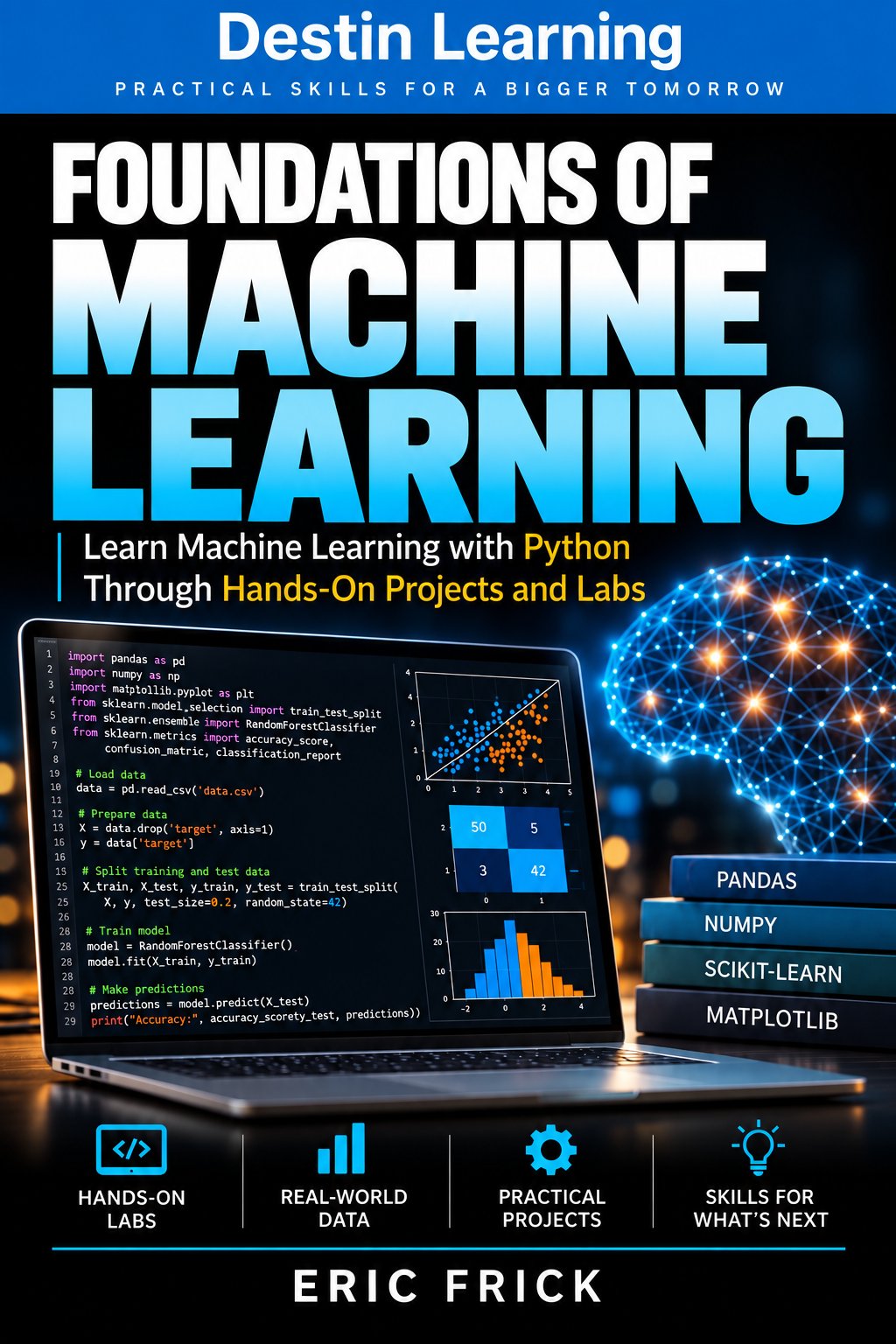
What you'll gain
You'll construct ColumnTransformer pipelines that handle imputation, scaling, and encoding in a single, leak-free workflow — the same structure used in real deployed systems.
You'll evaluate models with stratified cross-validation, compare classifiers across consistent metrics, and tune preprocessing and model hyperparameters together with GridSearchCV.
You'll save a full pipeline with joblib, reload it in a separate prediction script, and understand what production deployment of an ML model actually involves.
From Raw Data to Deployed Model

Who this course is for
You write Python comfortably and understand basic programming concepts but have limited exposure to machine learning workflows. You'll gain the practical skills to build, evaluate, and ship real ML models.
You've trained models before but want a rigorous foundation in pipelines, cross-validation, and data leakage prevention. This course closes the gaps and gives you reproducible patterns to apply on the job.
You've finished the prerequisite Foundations of Artificial Intelligence course and are ready to go deeper into applied machine learning. This course picks up directly where that one leaves off.
What you'll learn
The course opens by establishing a professional ML project structure and the scikit-learn estimator API, giving you a repeatable foundation before introducing any algorithms. From there, modules on EDA, preprocessing, feature engineering, and pipelines build systematically on each other — each concept appearing inside the pipeline structure before the next is added. The algorithm modules cover linear models, trees, random forests, gradient boosting, SVMs, and unsupervised methods, with dedicated modules on tuning and imbalanced data following naturally. The course closes with model interpretation, saving and serving pipelines, and a final end-to-end project.
Module 1
The Machine Learning Workflow
3 lessons
▾
Module 2
Exploratory Data Analysis
3 lessons
▾
Module 3
Data Cleaning and Preprocessing
3 lessons
▾
Module 4
Feature Engineering
3 lessons
▾
Module 5
Pipelines and ColumnTransformer
3 lessons
▾
Module 6
Model Evaluation and Validation
3 lessons
▾
Module 7
Linear Models Revisited
3 lessons
▾
Module 8
Decision Trees and Ensembles
3 lessons
▾
Module 9
More Algorithms Worth Knowing
3 lessons
▾
Module 10
Hyperparameter Tuning and Imbalanced Data
3 lessons
▾
Module 11
Unsupervised Learning in Practice
3 lessons
▾
Module 12
Deploying Models and Final Project
3 lessons
▾
Learn by doing
Each module includes a hands-on lab where you write real Python against real data using scikit-learn, pandas, Matplotlib, and NumPy in a standard Linux Python environment. Labs are designed to expose common mistakes — like data leakage and misleading accuracy on imbalanced sets — so you recognize and fix them in your own work. The 24 labs culminate in a full end-to-end project covering EDA, a preprocessing pipeline, model comparison, and hyperparameter tuning.
- Create a reproducible project script that loads a built-in scikit-learn dataset, splits it, and fixes the random seed
- Train a DummyClassifier baseline and a real classifier and compare their scores against the baseline
- Fit several different estimators through the same fit/predict interface and inspect their learned attributes
- Distinguish hyperparameters from learned parameters by printing get_params() and fitted attributes side by side
- Load a built-in dataset into a pandas DataFrame and produce a summary report of types, missing values, and distributions
- Identify outliers and skewed features using descriptive statistics
- Build and save a correlation heatmap and feature histograms with Matplotlib
- Identify the features most strongly related to the target and document findings in a text report
- Inject missing values into a dataset and compare model performance under different imputation strategies
- Compare a distance-based model's accuracy with and without feature scaling
- Build a small mixed-type DataFrame and apply one-hot and ordinal encoding with scikit-learn encoders
- Configure OneHotEncoder to handle categories that appear only at prediction time
- Create interaction and polynomial features and measure their effect on a regression model
- Apply recursive feature elimination to find a smaller feature set with comparable performance
- Reproduce inflated scores by fitting a scaler on the full dataset before splitting
- Fix the leak and compare the honest score against the leaked one
- Build a ColumnTransformer that imputes, scales, and encodes a mixed-type DataFrame
- Combine the preprocessor and a model into a single Pipeline and train it with one fit call
- Implement a custom transformer class that engineers new features
- Insert the custom transformer into a pipeline and verify it runs end to end
- Evaluate several models with stratified k-fold cross-validation and report mean and standard deviation of scores
- Use cross_validate to collect multiple metrics in a single run
- Plot and save ROC and precision-recall curves for a classifier
- Select a decision threshold that meets a target recall and report the resulting precision
- Implement batch gradient descent for linear regression in NumPy
- Compare the learned coefficients against scikit-learn's LinearRegression and plot the loss curve
- Fit Ridge and Lasso models across a range of alpha values and compare coefficients
- Use Lasso to identify which features the model drops entirely
- Train decision trees at several depths and compare training and test accuracy
- Export a trained tree's rules as text and interpret its top splits
- Train a single tree, a random forest, and a gradient boosting model on the same data
- Compare cross-validated scores and training times in a summary table
- Train SVMs with linear and RBF kernels on synthetic non-linear data from make_moons
- Visualize and save the decision boundaries for each kernel
- Evaluate at least five algorithms in pipelines on the same dataset with cross-validation
- Produce a ranked comparison table and justify a final algorithm choice
- Tune preprocessing and model hyperparameters together with GridSearchCV
- Compare the results of grid search and randomized search on the same pipeline
- Create an imbalanced dataset with make_classification and show why accuracy is misleading
- Improve minority-class recall using class weights and threshold adjustment
- Apply K-Means, agglomerative clustering, and DBSCAN to synthetic data with different shapes
- Score each result with the silhouette coefficient and save plots of the clusters
- Generate data with injected outliers and detect them with Isolation Forest
- Compare Isolation Forest and Local Outlier Factor detections against the known outliers
- Train a full pipeline, save it with joblib, and reload it in a separate prediction script
- Run batch predictions on new rows from a CSV file and write the results to disk
- Build an end-to-end project on a built-in dataset covering EDA, a preprocessing pipeline, model comparison, and tuning
- Evaluate the final model on a held-out test set, save it, and write a short results summary
Destin Learning
Destin Learning creates practical, project-driven courses for developers, IT professionals, and tech enthusiasts who want to build real skills — not just pass a certification exam.
Every course is built around hands-on labs, working code, and real-world tools. Our students learn by doing: writing programs, configuring systems, and solving problems in environments that mirror what they'll encounter on the job.
Our courses cover systems programming, Linux administration, cloud infrastructure, AI and machine learning, and foundational computer science — all taught with the same philosophy: understand it deeply, build it yourself, and know why it works.
Destin Learning · destinlearning.com
Enroll Now and Start Building
Lifetime access to all video lessons, hands-on labs, and course materials — learn at your own pace.
Have a coupon code? Redeem it here